

How Many Electrolytes Do You Need During Exercise?
Water is only part of the solution.
What matters is what you're losing when you sweat.
Quick Answer: For short, cool sessions, water is usually enough. For longer sessions, warm conditions or heavy sweaters, electrolytes matter.
If you are exercising for less than 60 minutes in cool conditions, water alone is usually adequate. For anything longer, hotter or sweatier, you need to think about what you are losing in sweat. As a practical starting point:
- Easy session under 60 minutes in cool conditions: water is usually enough
- Training day where you sweat: 1 electrolyte sachet in 500ml water
- Session over 60 minutes: 1 sachet per hour
- Warm or hot conditions: 1 to 2+ sachets per hour, depending on sweat rate
- Heavy sweater or hot race: practise the higher end in training
The principle is simple. Water replaces fluid. Electrolytes replace what sweat takes away. But in many sessions, truefuels gels already do part of this job. Every truefuels Performance Gel contains carbohydrate and electrolytes. That means that for many athletes, especially in cooler conditions, fuelling during a session or a race can be kept very simple. Use gels for carbohydrate and salt during exercise. Use Electrolytes when sweat losses are higher, or if you don’t want to ingest carbohydrates. Use Electrolytes before and after training to start and finish in balance. A useful rule is this: If a session is long or hard enough that you need carbohydrate, it is usually long or hard enough that electrolytes matter too.
Alistair's Perspective
"For years, I thought hydration meant drinking more. Eventually, I realised the better question wasn't just how much fluid I was losing. It was what I was losing in that fluid. Now my focus has shifted to ensure that I can perform at my best after the training session. In meetings and at work. I’ve found being intentional with my electrolyte intake before, during and after training to really help with my focus."
— Alistair Brownlee, two-time Olympic triathlon champion & truefuels co-founder

Why
The answer starts with sweat.
Sweat is not just water. It contains minerals known as electrolytes. The most important for endurance athletes are:
- Sodium
- Potassium
- Magnesium
- Chloride
- Calcium
These minerals carry electrical charge. That is why they are called electrolytes. They help regulate:
- Fluid balance
- Blood volume
- Nerve signalling
- Muscle contraction
- Cardiovascular function
Think of electrolytes as part of the body's communication system. Your muscles do not contract because they want to. They contract because electrical signals tell them to. Electrolytes help those signals work properly.
Why sodium matters most
All electrolytes matter. But during endurance exercise, sodium is usually the one to focus on first. Why?
Because sodium is lost in the greatest quantities through sweat. Some athletes lose relatively little sodium. Others lose a lot. Two athletes can run side by side, at the same pace, in the same conditions and still have very different sodium losses. That is why hydration strategy should be personal. It depends on:
- Sweat rate
- Temperature
- Humidity
- Exercise intensity
- Body size
- Fitness
- Heat adaptation
- Individual sweat sodium concentration
This is also why generic advice often fails. Some athletes need very little electrolyte replacement. Others need a lot.
How much sodium do athletes lose?
Sodium losses vary enormously. A light sweater in cool conditions may lose relatively little sodium. A heavy sweater in hot conditions can lose much more. A practical range often used for endurance athletes is approximately 200mg to 2,000mg sodium per hour, depending on sweat rate, temperature and intensity. This corresponds to approximately 500mg Salt to 5,000mg Salt. That range is wide because athletes are different. The important point is not to find one perfect number for everyone. The important point is to understand the direction. As sweat rate rises, sodium loss rises. As conditions become hotter, sodium loss usually rises. As duration increases, the deficit accumulates.
Why water alone is not always enough
Water matters. But water alone does not replace sodium. That is the problem. If you drink fluid without replacing electrolytes during long or hot sessions, you may restore water but not the minerals lost in sweat. In some situations, drinking very large amounts of plain water without sodium can dilute blood sodium. That is called hyponatraemia. It can cause nausea, headache, confusion and, in severe cases, serious medical problems. This does not mean you should avoid water. It means you should understand what water does and what it does not do. Water replaces fluid. It does not replace sodium.

So What
The physiology is interesting. What matters is how it changes your strategy.
Knowing that sweat contains sodium, potassium and magnesium does not make you faster. Knowing what to do with that information does. For most endurance athletes, the objective is simple:
- Replace fluid.
- Replace electrolytes.
- Start before the deficit becomes large.
- Practise the strategy in training.
- Adjust intake when conditions change.
You do not need to turn hydration into maths. You need a system you can repeat.
How many electrolyte sachets should I take?
Think in conditions.
| Situation | truefuels strategy |
|---|---|
| Session under 60 minutes in cool conditions | Water is usually enough |
| Training day where you sweat | 1 sachet in 500ml water |
| Session over 60 minutes in cool conditions | 1 sachet per hour (or electrolytes from gels) |
| Warm conditions above 22°C | 1 to 2 sachets per hour (or electrolytes from gels) |
| Hot conditions or heavy sweater | Up to 2 sachets per hour if practised (or electrolytes from gels) |
| Post training | 1 sachet in 500ml water |
The exact number will vary between athletes. The strategy does not have to be complicated. Start with one sachet. Increase when the session becomes longer, hotter or sweatier.
Do I need electrolytes if my gels already contain salt?
Sometimes the answer is no. That is one reason we built salt into every truefuels Performance Gel. During exercise, most athletes are trying to solve two problems at the same time:
- Supplying carbohydrate
- Replacing some of the salt lost through sweat
truefuels gels do both.
The Performance Gel 40/0.25 provides 40g carbohydrate with 0.25g salt (approx 100mg Sodium).
The Performance Gel 40/1.0 provides 40g carbohydrate with 1g salt (approx 400mg Sodium).
This means that for many sessions, especially in cool or moderate conditions, you can keep during session fuelling simple and use gels as the main fuel source.
But there are situations where you may need additional electrolytes:
- Hot conditions
- Heavy sweating
- Long sessions
- Indoor training
- Racing in humidity
- Cramp prone athletes
- Athletes with visible salt marks on clothing
- Times when you need electrolytes without extra carbohydrate
That is where truefuels Electrolytes fit. The gels cover fuel and some salt. Electrolytes give you extra control when sweat losses are higher.
"The best hydration strategy isn't the one with the biggest bottle. It's the one that replaces what you're actually losing. Sometimes that can come from truefuels gels. Sometimes you need extra electrolytes. The point is to know the job each product is doing."
Alistair Brownlee

A Common Mistake
"I only need electrolytes on race day."
I hear this all the time. People treat electrolytes like an emergency product. Something to take when it is hot. Something to take when they cramp. Something to take on race morning. But electrolyte loss is not only a race day problem. You sweat in training. You sweat indoors. You sweat in winter. You sweat on easy days. The amount changes. The requirement does not disappear. If you train consistently, small daily losses can accumulate across the week, especially when training load is high or conditions are warm. That is why electrolytes should not be seen only as a race day product. They are part of the training system. The goal is not to rescue a bad hydration strategy. The goal is to start the next session in balance.
"I often made the mistake of treating hydration as something that only mattered during the race. I realised it was something I had to manage every day. Race day should just be an extension of the habits you built in training."
Alistair Brownlee

Now What
Build electrolytes into your training routine.
Your fuelling strategy should not start on race day. Your hydration strategy should not either. Build your electrolyte routine around three moments:
| When | Dose | Conditions | Why |
|---|---|---|---|
| Morning on waking | 1 sachet in 500ml | All training days | Replaces overnight losses. Starts the day in balance. |
| During sessions over 60 minutes | 1 per hour cool. 1 to 2 per hour above 18°C (or electrolytes from gels) | Cool, warm or hot | Replaces active sweat losses. Maintains neuromuscular function. |
| Post training | 1 sachet in 500ml | All training days | Accelerates electrolyte restoration. Supports next day readiness. |
20 sachets per box gives approximately 6 to 10 days of daily training supply. This is not only a race day product. It is a weekly training staple.

Electrolytes for endurance sport
Why do endurance athletes need electrolytes?
Endurance exercise is long enough for small losses to become large losses. During short exercise, the body can usually manage fluid and electrolyte shifts without much support. During longer exercise, especially in warm conditions, sweat losses accumulate. That can affect:
- Plasma volume
- Heart rate
- Thermoregulation
- Muscle function
- Perceived effort
- Recovery
This is why electrolytes matter more as sessions become longer, hotter or more intense. The longer the event, the more important the system becomes.
If you need carbs, you probably need to think about electrolytes too.
This is a simple way to decide. If a session is long or hard enough that you need carbohydrate during exercise, it is usually long or hard enough that sweat losses matter too. That does not mean you always need a separate electrolyte sachet during the session. truefuels gels already contain salt, so for many athletes the gel does both jobs during exercise. But it does mean electrolytes should be part of the plan. Sometimes that means salt from the gel. Sometimes that means an electrolyte sachet before or after. Sometimes that means both. The key is to think about fuelling and hydration together. Carbohydrate keeps energy available. Electrolytes help replace what sweat takes away.

Electrolytes vs water
Should I drink electrolytes instead of water?
Not always. Sometimes water is enough. The question is not whether electrolytes are always better than water. The question is what problem you are trying to solve. Water replaces fluid. Electrolytes replace what sweat takes away. For short, easy short sessions in cool conditions, water is usually enough. For longer sessions, hot conditions or heavy sweaters, electrolytes become more important. In many endurance situations, the best answer is not water or electrolytes. It is water with electrolytes.
Signs of low electrolytes during exercise
Electrolyte issues do not always feel obvious at first. Possible signs include:
- Excessive fatigue for the effort
- Headache
- Nausea
- Dizziness
- Muscle twitching
- Cramping
- Unusually high heart rate
- Feeling washed out after training
These signs can have many causes. Do not assume every bad session is an electrolyte problem. But if symptoms appear repeatedly during long, hot or sweaty sessions, electrolyte intake is worth reviewing.
How to build a hydration guide for athletes
Keep it simple. Ask five questions:
- How long is the session?
- How hot is it?
- How much do I sweat?
- Am I a salty sweater?
- How did I feel last time?
Then adjust. If the session is short and cool, water may be enough. If the session is long, hot or sweaty, use electrolytes. If you finish sessions covered in salt marks, regularly cramp or feel unusually depleted, your sodium needs may be higher. The best strategy is the one you practise, observe and adjust.
Why we built truefuels Electrolytes
Most electrolyte products try to be everything. We wanted ours to do one job well. Replace what sweat takes away. That matters because the truefuels system is designed to be stackable. Our gels already contain carbohydrate and salt, so for many athletes during session fuelling can remain simple. Use gels to supply carbohydrate and salt during exercise. Electrolytes are there for the moments when you need more control:
- Daily hydration
- Before training
- After training
- Hot conditions
- Heavy sweat losses
- Long sessions
- Times when you need electrolytes without more carbohydrate
The aim is not to make athletes combine more products. The aim is to give them control without making the strategy complicated. Each truefuels electrolyte sachet provides:
- 400mg sodium
- 150mg potassium
- 25mg magnesium
It is designed to be used in 500ml water. Simple ingredients. Simple dosing. Simple strategy. The objective was not to create another complicated sports drink. It was to create a daily hydration tool that stacks with the rest of the truefuels system.
"I wanted electrolytes to be simple. Not a product you only think about when something has already gone wrong, but something that fits into training every day. Replace what you lose. Keep the system working."
Alistair Brownlee
Which products should you use?
| Goal | Recommended product |
|---|---|
| Daily hydration | Electrolytes |
| Sessions over 60 minutes | Electrolytes or gels depending on conditions |
| During session carbohydrate and salt | Performance Gel 40/0.25 or 40/1.0 |
| Hot training or heavy sweating | Electrolytes plus Performance Gel 40/1.0 |
| Heat preparation | CoreCtrl |
| Gut training block | Training Bundle |
| Complete race strategy | Race Ready System |

Electrolytes
400mg sodium, 150mg potassium and 25mg magnesium per sachet. Designed for daily training hydration and electrolyte replacement. Use in 500ml water.
Shop Electrolytes →
Performance Gel 40/1.0
40g carbohydrate with 1g salt. A simple option when you need carbohydrate and higher salt during warmer conditions, hot races or heavy sweat sessions.
Shop Performance Gel 40/1.0 →
Performance Gel 40/0.25
40g carbohydrate with 0.25g salt. A simple option when you need carbohydrate and some salt during training or racing in cooler conditions.
Shop Performance Gel 40/0.25 →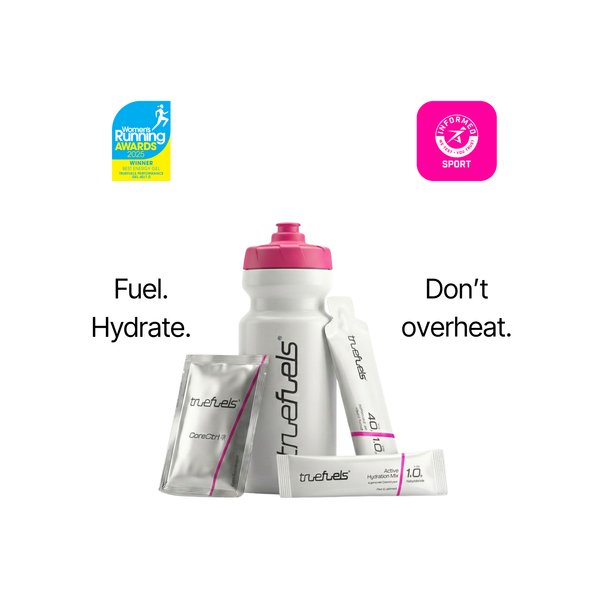
Race Ready System
40 gels, 20 electrolytes, 8 CoreCtrl and a bottle. A complete system for athletes preparing for demanding events, hot races or longer endurance goals.
Shop Race Ready System →One rule to remember
Water replaces fluid.
Gels provide carbohydrate and salt.
Electrolytes give you extra control when sweat losses are higher.
Frequently Asked Questions
For sessions under 60 minutes in cool conditions, water alone is usually adequate.
For anything longer or in warm conditions, usually not.
Sweat contains sodium, potassium and magnesium. Water replaces fluid, but it does not replace the minerals lost in sweat. The deficit can compound across long sessions and repeated training days.
Sodium loss varies widely between athletes.
A practical range is approximately 200mg to 2,000mg sodium per hour depending on sweat rate, temperature, intensity and individual sweat sodium concentration.
Heavy sweaters in hot conditions are usually at the higher end.
A truefuels electrolyte sachet contains g Salt (400mg sodium) per serving.
Drinking large volumes of plain water without electrolytes can dilute blood sodium.
This is called hyponatraemia.
Symptoms can include nausea, headache and confusion. In severe cases it can become dangerous.
More water without electrolytes is not always safer.
For long or hot sessions, fluid and sodium should be considered together.
Yes, if you sweat.
The amount may be lower than during hard or hot sessions, but electrolyte loss still occurs.
One sachet in morning water on training days can act as a simple maintenance dose, especially when training load is high, conditions are warm or you are prone to feeling depleted after sessions.
As a practical guide, take 1 sachet per hour in cool conditions when sessions last over 60 minutes.
In warm or hot conditions above 22°C, take 1 to 3 sachets per hour depending on sweat rate.
Heavy sweaters may need the higher end.
Also consider 1 sachet on waking and 1 after training during heavy training blocks.
Not always during the session.
Every truefuels Performance Gel contains carbohydrate and salt, so many athletes can use gels as their main during session fuel source, especially in cool or moderate conditions.
But if the session is long, hot or sweaty, or if you need electrolytes before or after training, truefuels Electrolytes give you extra control without adding more carbohydrate.
A useful rule is this: if a session is long or hard enough that you need carbs, it is usually long or hard enough that electrolytes matter too.
Electrolytes are minerals that carry electrical charge in the body.
They include sodium, potassium, magnesium, chloride and calcium.
They help regulate fluid balance, nerve signalling, muscle contraction and cardiovascular function.
During endurance exercise, sodium is usually the main electrolyte to focus on because it is lost in the greatest quantities through sweat.
Athletes need electrolytes because sweat contains more than water.
During longer, hotter or more intense sessions, sodium and other electrolyte losses accumulate.
Replacing electrolytes helps support fluid balance, neuromuscular function and performance.
Water matters, but water alone does not replace what sweat takes away.
Yes, especially for long runs, warm conditions, heavy sweaters or runners who often feel depleted after training.
For easy runs under 45 to 60 minutes in cool conditions, water is usually enough.
For long runs over 60 minutes, 1 sachet per hour is a practical starting point.
If you are also using truefuels gels during the run, remember that the gels already contain salt.
Yes.
Cycling sessions often last long enough for sweat and sodium losses to become meaningful.
For rides over 60 minutes, 1 sachet per hour is a useful starting point.
In warm conditions, long sportives or indoor sessions where sweat rate is high, 1 to 2 sachets per hour may be more appropriate.
If you are taking truefuels gels during the ride, the gels already provide carbohydrate and salt.
Yes.
Electrolyte intake should match sweat losses, conditions and the individual athlete.
More is not automatically better.
Very high sodium intake may cause stomach discomfort or excessive thirst in some athletes.
The aim is to replace what you lose, not maximise intake.
Yes, both can be useful.
One sachet in 500ml water on waking can help start the day in balance.
One sachet after training can help restore electrolyte losses and support next day readiness.
During sessions over 60 minutes, take electrolytes during exercise as well if gels alone are not enough for the conditions.
Salt is sodium chloride.
Sodium is the part most relevant to endurance hydration because it is lost in sweat and helps regulate fluid balance.
Athletes often talk about salt, but nutrition labels usually list sodium.
Both matter, but they are not exactly the same thing.
Continue Your Learning
Understanding electrolytes is only one part of endurance performance. Continue exploring the science:

Nutrition for Training in the Heat
Why hot conditions change carbohydrate, fluid and electrolyte requirements.
Read Nutrition for Training in the Heat
How Many Carbs Per Hour Do You Actually Need?
Learn how carbohydrate absorption, gut training and fuelling strategy determine endurance performance.
Read How Many Carbs Per Hour
Why Muscles Cramp During Exercise
Understand why cramps happen, why water alone is not enough and how electrolyte strategy fits into prevention.
Read Cramp Prevention
Nutritional Best Practices for Endurance Athletes
A broader guide to endurance fueling, carbohydrate intake and performance nutrition.
Read Nutritional Best PracticesBuild Your Personal Strategy
Every athlete is different.
Your hydration strategy should depend on:
- Session duration
- Temperature
- Sweat rate
- Sodium loss
- Intensity
- Training load
- Experience
- Whether you are already taking salt through gels
Use the truefuels Fuel Calculator to calculate:
- Recommended carbohydrate intake
- Electrolyte requirements
- Product recommendations
- Timing strategy
"The best hydration strategy is not the one that sounds most scientific. It is the one you practise often enough to understand. Replace what you lose. Keep the system simple. Make the next session better."
Alistair Brownlee