

Get your personalised fuelling plan.
Use the calculator below to build your plan. It takes less than 60 seconds.
If you have tested your sweat rate or sodium concentration, entering these will sharpen the fluid and electrolyte recommendations. Leave blank to use the algorithm's estimates.
Algorithm informed by published research on exercise fluid replacement, sweat rate, sweat sodium concentration and carbohydrate use during endurance exercise, including Sawka et al. (2007), Jeukendrup (2011) and Baker (2017). Constants: 40 g carbohydrate per gel, 1 g salt per high-salt gel, 0.25 g salt per low-salt gel and 1 g salt per electrolyte serving. Scientific estimate only. Individual variation exists. Validate all recommendations in training before race day.
Quick answer: Don’t guess your race nutrition.
A good fuelling plan answers four questions:
- How much carbohydrate do I need per hour?
- How many gels does that mean?
- How much salt and electrolyte support do I need?
- When exactly should I take everything?
The truefuels system makes this simple.
Every truefuels Performance Gel contains 40 g carbohydrate.
That means your plan can be built in simple steps:
- 1 gel per hour = 40 g carbohydrate
- 2 gels per hour = 80 g carbohydrate
- 3 gels per hour = 120 g carbohydrate
For most marathon runners, cyclists and triathletes, 2 gels per hour is a strong target when practised in training. First-time users may start lower. Experienced athletes may go higher. Hot conditions may require more electrolytes and higher salt. The calculator does the maths for you.
"The best race nutrition plan is not the most complicated one. It is the one you can still follow when you are tired and under a lot of stress. When I realised that trying to calculate grams of carbohydrate, salt or timings halfway through a race was a recipe for trouble, my nutrition became much more reliable. I wanted a plan that was simple enough to execute under pressure."
Alistair Brownlee


How the calculator works
We turn your race into a simple fuelling schedule.
Your plan is based on five main inputs:
- Expected duration
- Sport or event type
- Temperature
- Sweat profile
- Gut tolerance
From there, the calculator estimates:
- Your carbohydrate target
- Your gel count
- Your salt requirement
- Your electrolyte plan
- Your timing schedule
- Your matched products
Your carbohydrate target
Carbohydrate needs depend on duration, intensity, experience and gut tolerance. First-time users usually start lower. Experienced athletes can often tolerate more. Hot conditions can increase the cost of sustaining pace and make fuelling harder to execute, so your carbohydrate plan needs to be practised in training. As a simple starting point:
| Athlete type | Starting target |
|---|---|
| First time or cautious | Around 40 to 60 g carbohydrate per hour |
| Experienced endurance athlete | Around 80 g carbohydrate per hour |
| High carbohydrate trained athlete | 100 g to 120 g carbohydrate per hour |
| Hot race | Increase only if practised |
The aim is not to consume the most carbohydrate possible. The aim is to absorb the most carbohydrate you can tolerate consistently.
Your gel count
Every truefuels Performance Gel contains 40 g carbohydrate. The calculator converts your target into a simple gel number. For example:
| Duration | Target | Approximate gel count |
|---|---|---|
| 2 hours | 80 g per hour | 4 gels |
| 3 hours | 80 g per hour | 6 gels |
| 4 hours | 80 g per hour | 8 gels |
| 5 hours | 80 g per hour | 10 gels |
You do not need to calculate 73 g or 87 g. You just need to know how many gels to carry and when to take them.
Your salt and electrolyte plan
Fuel and hydration should be planned together. truefuels gels already contain carbohydrate and salt. That means for many races, especially in cool or moderate conditions, gels can do two jobs:
- Supply carbohydrate
- Replace some of the salt lost through sweat.
The calculator then adds extra Electrolytes when needed. As conditions become hotter, sweat losses usually rise. As sweat losses rise, electrolyte requirements usually rise too. Water replaces fluid. Gels provide carbohydrate and salt. Electrolytes give you extra control when sweat losses are higher.
Your timing schedule
Most race nutrition problems happen because athletes start too late. The calculator gives you a timing plan, so you know when to start and how often to fuel. As a practical guide:
- Optional pre-start gel: 5 to 10 minutes before the race
- First in-race gel: usually within the first 30 to 45 minutes
- Subsequent gels: every 30 to 45 minutes depending on your target
- Electrolytes: before, during or after depending on the session
- Hot races: consider CoreCtrl in the days before the event
Race day is not the time to improvise.

A common mistake
“I’ll just work it out during the race.”
This is one of the easiest ways to get nutrition wrong. Trust me, I've been there. Early in the race, everything feels manageable. You think you can decide later. But later is when the decisions get harder. You are tired. Your stomach may be more sensitive. You are trying to pace, navigate, respond to competitors, manage aid stations and stay focused. That is not the moment to start doing nutrition maths. The better approach is simple. Calculate it before the race. Practise it before the race. Execute it during the race.
"Nobody makes better nutrition decisions late in a race. You make the good decisions before the race starts. The plan should already be built, practised and simple enough that you do not have to think about it."
Alistair Brownlee

What your result means
Your gel count
This is the total number of gels you should plan to use during your session or race. Always carry enough for the full plan. When I raced, I preferred to rely on aid stations for water only. That meant I knew exactly what fuel and salt I was carrying, and I left as little as possible to chance.
Your gel type
The calculator will recommend the gel type based on conditions and sweat profile.
| Conditions | Recommended gel |
|---|---|
| Cool conditions | Performance Gel 40/0.25 |
| Warm conditions | Mix 40/0.25 and 40/1.0 |
| Hot conditions | Performance Gel 40/1.0 |
| Heavy sweater | Performance Gel 40/1.0 plus Electrolytes |
The carbohydrate stays simple. The salt adapts to the conditions.
Your electrolyte schedule
Your electrolyte plan depends on duration, temperature and sweat rate. As a simple guide:
| Conditions | Electrolyte starting point |
|---|---|
| Cool conditions | 1 sachet before or after, or 1 per hour if sweating heavily |
| Warm conditions | 1 sachet per hour |
| Hot conditions | 1 to 2 sachets per hour depending on sweat rate |
| Heavy sweater | Practise the higher end in training |
If your gels already provide enough salt for the conditions, you may not need extra Electrolytes during the session. If sweat losses are higher, Electrolytes give you extra control.
Your heat recommendation
If your race is warm or hot, the calculator may recommend CoreCtrl. CoreCtrl is designed to be used as part of a heat preparation strategy before the event. It is not a rescue product. It works best alongside:
- Heat adaptation
- Appropriate carbohydrate intake
- Electrolyte replacement
- Sensible pacing
- Race day practice
Your recommended products

Performance Gel 40/1.0
40 g carbohydrate with 1 g salt. Recommended for warm races, hot conditions, heavy sweaters or athletes who need carbohydrate and higher salt in the same product.
Shop Performance Gel 40/1.0 →
Performance Gel 40/0.25
40 g carbohydrate with 0.25 g salt. Recommended for cool conditions, steady endurance events and athletes who need carbohydrate with a lower salt load.
Shop Performance Gel 40/0.25 →
Electrolytes
400 mg sodium, 150 mg potassium and 25 mg magnesium per sachet. Recommended alongside gels for daily hydration, pre-race preparation, post-race recovery and sessions where sweat losses are higher.
Shop Electrolytes →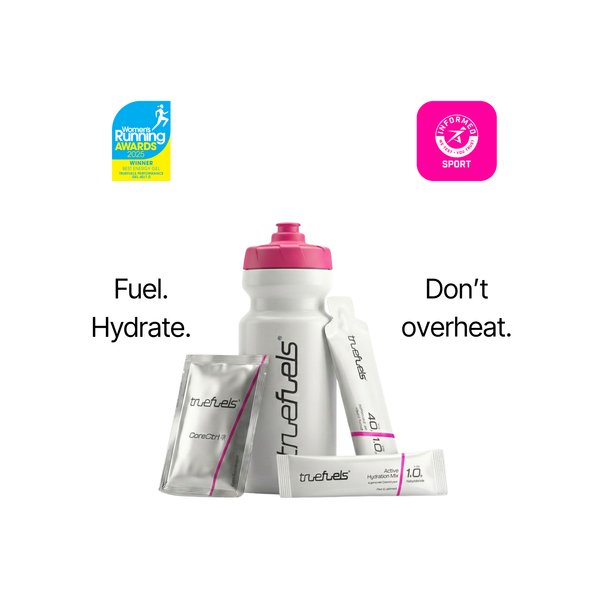
Race Ready System
40 gels, 40 electrolytes, 8 CoreCtrl and a bottle. Best for athletes preparing for longer races, hot races or events requiring a full fuelling and hydration system. If your calculator result requires a higher gel count or extra heat preparation, the Race Ready System may be the simplest option.
Shop Race Ready System →Get your free personalised marathon fuel plan.
Personalised gel and electrolyte plan based on your race distance, conditions and target time.
Your fuel plan is on its way.
Check your inbox — usually arrives within a few minutes.
No spam. One email with your plan. Unsubscribe anytime.
From the founder
"I built truefuels to help you be your best. It was built on a simple idea: fuelling should not be the thing that lets you down.
The best race nutrition plan is not the most complicated one. It is the one you can still follow when you are tired. This calculator helps you put the right products together, in the right amounts, at the right time.
It will not be perfect for every athlete in every situation. No calculator can be. But it gives you a strong starting point.
Calculate the plan. Practise it in training. Adjust it if needed. Then make race day simple."
— Alistair Brownlee, two-time Olympic triathlon champion & truefuels co-founder
Three Problems. One System.
Endurance nutrition usually fails for one of three reasons. You run out of fuel. You lose too much through sweat. You overheat. The truefuels system was built to solve those problems simply.
Hitting the wall
Energy Gels

At moderate to high intensity, carbohydrate is the fuel your body relies on most.
Every truefuels gel contains 40 g carbohydrate, making your plan simple:
- 1 gel per hour = 40 g
- 2 gels per hour = 80 g
- 3 gels per hour = 120 g
Think in gels, not grams.
Losing what sweat takes away
Electrolytes

Sweat is not just water. It contains sodium and chloride, plus smaller amounts of potassium and magnesium.
truefuels gels already contain salt, so many athletes can keep during-session fuelling simple with gels.
Electrolytes give you extra control when sweat losses are higher, or when you need electrolytes without extra carbohydrate.
Heat
CoreCtrl

Heat changes the race. It increases cardiovascular strain, sweat losses and the cost of sustaining pace.
CoreCtrl was designed as part of a heat preparation strategy for warm and hot events.
It works best alongside heat adaptation, carbohydrate intake, electrolyte replacement and sensible pacing.
Race day timing example
Example: 4-hour race at 80 g carbohydrate per hour
This is an example only. Your calculator result may be different.
| Time | Action |
|---|---|
| 30 min before start | Electrolytes in 500 ml water |
| 5 min before start | 1 gel |
| 30 min | 1 gel |
| 60 min | 1 gel |
| 90 min | 1 gel |
| 120 min | 1 gel |
| 150 min | 1 gel |
| 180 min | 1 gel |
| 210 min | 1 gel |
| Finish | Electrolytes post-race |
This gives approximately 8 gels during the race. Some athletes may need more. Some may need less. That is why the calculator starts with your race, not a generic plan.
One rule to remember
Calculate it. Practise it. Execute it.
The perfect fuelling plan is not the one that looks best on paper.
It is the one you have practised enough that race day feels simple.
Frequently Asked Questions
Use the truefuels fuelling plan calculator above. Input: marathon, your expected finish time and conditions. As a starting point, at 60 g to 80 g carbohydrate per hour for a 3:30 to 4:00 marathon, you need approximately 6 to 9 gels, with 40 g carbohydrate per gel. The calculator gives your exact number.
A race day fuel plan is a personalised schedule showing what to take, how much to take and when to take it during your race. It should include gels, electrolytes, fluid, timing and heat preparation if conditions are warm or hot.
Keep it simple. Start with a realistic carbohydrate target, practise in long runs and avoid trying anything new on race day. Many first-time marathon runners start around 60 g carbohydrate per hour and build from there if tolerated. truefuels gels contain 40 g carbohydrate each, so the calculator turns your race time into a simple gel count and timing plan.
Yes. The truefuels fuelling plan calculator is free. Enter your sport, expected finish time, conditions and experience level, and it will estimate your carbohydrate target, gel count, electrolyte schedule, timing and product recommendations.
A fuelling calculator estimates your race nutrition based on expected duration, carbohydrate target, conditions, sweat profile and experience level. It then converts your carbohydrate requirement into a gel count and timing schedule. The truefuels calculator also considers salt and electrolyte needs, because race fuelling is not just about carbohydrate.
It is based on published academic literature on relevant topics, such as fluid loss, fluid replacement, sodium sweat concentration and exogenous carbohydrate metabolism. Alistair wanted to base the calculation on available evidence, but this does not answer everything. The calculator has been tested by a wide range of athletes, including our co-creators, to gather feedback on every possible scenario we could think of. It will not be perfect for every athlete in every situation. No calculator can be. If you see something you think is off, please get in touch. We’d love to hear from you.
It depends on your expected finish time and intensity. Many athletes racing for around 90 minutes to 2 hours may need 1 to 3 gels. Faster athletes may need fewer during the race, while athletes spending longer on course may need more. Use the calculator to match your gel count to your actual race duration.
Ironman fuelling depends heavily on your expected race time, bike duration, run duration, conditions and gut training. Most athletes need a full fuelling system rather than a small number of gels. Use the calculator for an initial plan, then use the Ironman Nutrition Guide for a more detailed race-specific strategy.
Use 40/0.25 when you need carbohydrate with a lower salt load, usually in cooler conditions or lower sweat sessions. Use 40/1.0 when conditions are warmer, sweat losses are higher, or you know you need more salt. The calculator will recommend the best option based on your session and sweat profile.
Continue your learning
Understanding electrolytes is only one part of endurance performance. Continue exploring the science:

How Many Carbs Per Hour Do You Actually Need?
Learn how carbohydrate absorption, gut training and fuelling strategy determine endurance performance.
Read How Many Carbs Per Hour
Electrolytes Explained
Why water alone is not enough and how sodium influences performance.
Read Electrolytes Explained
Nutrition for Training in the Heat
Why hot conditions change carbohydrate, fluid and electrolyte requirements.
Read Nutrition for Training in the Heat
Cramp Prevention
Why cramps are rarely one thing and why prevention starts before race day.
Read Cramp Prevention
Ironman Nutrition Plan
A complete race day fuelling guide for long course triathlon.
Read Ironman Nutrition PlanOne final thought
"The perfect fuelling plan is not the one that looks best on paper. It is the one you have practised enough that it feels automatic, so you are confident that it will not let you down on race day. Calculate the plan, test it in training and make race day execution simple."
— Alistair Brownlee, two-time Olympic triathlon champion & truefuels co-founder