

How many carbs per hour do you actually need?
Most endurance athletes don't run out of fitness.
They run out of fuel.
Quick answer: how many carbs per hour?
Most athletes should think in 40 g steps. For most endurance efforts, somewhere between 40 g and 120 g of carbohydrate per hour is appropriate — depending on intensity, duration and the individual. Don't obsess over tiny differences. Think in truefuels gels:
- 1 gel = 40 g
- 1 gel = 40 g
- 2 gels = 80 g
- 3 gels = 120 g
For the vast majority of marathon runners, Ironman athletes and cyclists, 2 truefuels gels per hour (80 g) works extremely well when combined with proper gut training. Only athletes racing at very high intensity need to push higher; lighter or lower-intensity athletes can sit comfortably on less.
Alistair's Perspective
"When I started racing, everyone talked about fitness. Fuelling was an afterthought. Over longer races, nutrition becomes one of the biggest determinants of performance. You can only express your fitness if you keep supplying your muscles with fuel."
— Alistair Brownlee, two-time Olympic triathlon champion & truefuels co-founder

Why
The answer lies in how your body stores and absorbs carbohydrate.
Carbohydrate is the dominant fuel source during moderate to high intensity endurance exercise.
When you eat carbohydrates, they are broken down into glucose and transported through the bloodstream. Some is used immediately for energy, while the rest is stored as glycogen in your muscles and liver. Think of glycogen as your fuel tank.
The problem is that the tank is relatively small. Even a well fuelled athlete only stores enough carbohydrate for a few hours of hard exercise. Once those stores begin to run low, performance declines rapidly.
This is what runners call "hitting the wall" and cyclists call "bonking." The solution is not simply taking more carbohydrate. The solution is making sure your body can absorb it.
Why can't you just eat more?
For years, sports nutrition advice suggested that athletes should consume around 60 g of carbohydrate per hour. People assumed this was because the body didn't need any more.
It wasn't. It was because the gut struggled to absorb more.
The small intestine contains specialised transporters that move carbohydrate from the gut into the bloodstream. Glucose and maltodextrin primarily use one transporter called SGLT1, while fructose uses a different transporter called GLUT5.
If you keep sending carbohydrate down one pathway, it eventually becomes saturated. The excess remains in the gut, increasing osmotic load and often causing bloating, nausea or diarrhoea. Many athletes think they "can't tolerate gels." In reality, they often can't tolerate poor absorption.
Why truefuels uses a 1:1 ratio
The obvious solution is to use both transport pathways. Many products combine glucose and fructose, but the specific 1:1 maltodextrin to fructose ratio used in truefuels gels allows both transporters to work together while keeping the formulation simple and predictable.
We also believe that less is more.
Many sports nutrition products contain unnecessary flavours, gums, emulsifiers and other ingredients that may increase the likelihood of gastrointestinal distress during exercise.
The truefuels philosophy is different. Give the body what it needs and leave everything else out.
Every truefuels Performance Gel provides:
- 40 g carbohydrate
- A 1:1 maltodextrin to fructose ratio
- Two salt options to match conditions
- A clean formulation designed for consistent use
This means fuelling becomes simple. You don't have to calculate whether you need 67 g or 93 g of carbohydrate. You simply decide whether today's session requires:
- 1 gel per hour (40 g)
- 2 gels per hour (80 g)
- 3 gels per hour (120 g)
The science is important. What matters is that you can execute the strategy when you're three hours into a race and no longer thinking clearly.
"One of the biggest mistakes athletes make is trying to find the perfect nutrition strategy on race day. The best strategy is usually the simplest one. When you're exhausted, you don't want to be doing maths and having to combine multiple products. You want a plan you've practised so often that it becomes automatic."
Alistair Brownlee

So what
What matters is how it changes your strategy.
Knowing that the gut contains two carbohydrate transporters doesn't make you faster. Knowing what to do with that information does. For most endurance athletes, the objective is simple:
- Keep supplying carbohydrate before your stores become depleted.
- Absorb it efficiently.
- Practise your strategy until it becomes automatic.
The exact number will vary between athletes, but your strategy doesn't need to be complicated. Think in truefuels gels, not grams.
| Session | truefuels strategy | Carbohydrate |
|---|---|---|
| Easy session under 1 hour | Usually none required | 0 to 40 g |
| 1 to 2 hour easy endurance session | 1 gel per hour | 40 g |
| Marathon, Ironman bike, long ride or intense session | 2 gels per hour | 80 g |
| Very high intensity or elite racing | Up to 3 gels per hour if practised | 120 g |
You don't eat 73 g of carbohydrate. You take another gel.
That is why every truefuels Performance Gel contains 40 g of carbohydrate. It allows athletes to build a fuelling strategy using simple multiples that are easy to remember when they are tired.
How many carbs per hour for running?
For easy runs under 60 minutes, most athletes do not need additional carbohydrate during the session.
For long runs over 90 minutes, start with 1 truefuels gel per hour (40 g carbohydrate) and build towards 2 gels per hour (80 g carbohydrate) if the session is long, intense or race specific.
For marathon racing, many athletes perform well on 2 truefuels gels per hour, provided they have practised this in training.
How many carbs per hour for cycling?
Cycling is usually easier on the gut than running because there is less impact. That means many cyclists can tolerate slightly higher carbohydrate intake, especially during long rides, sportives and Ironman bike legs.
For most long rides, 2 truefuels gels per hour (80 g carbohydrate) is a practical and reliable target.
For very long, intense or race specific rides, 3 gels per hour (120 g carbohydrate) may be appropriate, but only if practised.
How many carbs per hour for Ironman?
Ironman nutrition is different because the race is long enough for small mistakes to become big problems. For most Ironman athletes, the bike is where the majority of fuelling should happen.
A simple starting point is:
- Bike: 2 truefuels gels per hour
- Run: 1 to 2 truefuels gels per hour depending on gut tolerance
- Hot conditions: consider high salt gels and electrolytes
More aggressive athletes may build towards 3 gels per hour on the bike, but this should be trained well before race day.
"One thing I learnt over twenty years of racing is that simple plans survive pressure. The best nutrition strategy isn't the most complicated one. It's the one you can still follow when you're three hours into a race and no longer thinking clearly."
Alistair Brownlee

A common mistake
"I'm not elite, so I don't need elite fuelling."
I hear this all the time. People assume that because they are running a four hour marathon rather than a two hour marathon, nutrition doesn't matter as much.
I would argue the opposite. Elite athletes spend less time exercising. Recreational athletes often spend twice as long on the course. Their muscles need fuel for longer and their gut has to keep absorbing carbohydrate for longer.
So why would you deliberately choose a product that is:
- More likely to irritate your stomach?
- Slower to absorb?
- Harder to tolerate?
- More complicated to use?
You wouldn't buy slower running shoes because you're not an elite runner. You wouldn't choose a worse bike because you're riding more slowly.
Nutrition is no different.
The body doesn't know whether you're trying to win the Olympics or finish your first marathon. It still wants carbohydrate that is easy to absorb. It still wants to replace what you're losing. And because many recreational athletes are exercising for longer, getting nutrition right may actually be even more important.
"People often tell me they don't need elite nutrition because they aren't elite athletes. I don't really understand that logic. The physiology is exactly the same. If anything, someone exercising for five hours has even more reason to choose nutrition that is easy to absorb and unlikely to upset their stomach."
Alistair Brownlee

Now what
Your muscles adapt to training. Your cardiovascular system adapts to training. Your gut adapts to training too. Many athletes assume they "can't tolerate" high carbohydrate intake. Often, they simply haven't trained for it.
Your gut contains transporters that absorb carbohydrates. As with many physiological systems, repeated exposure improves their ability to perform their jobs. Increasing the number and activity of transporters in the gut wall allows glucose and fructose to pass at a higher rate.
This means nutrition should be practised in training exactly as you intend to use it in competition.
What is gut training?
Gut training is the process of practising carbohydrate intake during exercise so your body becomes better at tolerating and absorbing fuel. You can't decide on race morning to take 120 g per hour. Your gut needs training, exactly like your legs. Remember that what tastes good while you're walking around an expo is not necessarily what will taste good four hours into an Ironman or thirty kilometres into a marathon. Practise with the exact products you intend to race with.
A simple progression
Don't jump from one gel per hour to three. Build gradually.
Train during different sports if you're a triathlete. Your tolerance will usually be lower during running and at higher intensities.
| Week | Strategy | Carbohydrate |
|---|---|---|
| 1 | 1 gel per hour | 40 g |
| 2 | 1 gel per hour | 40 g |
| 3 | 2 gels per hour | 80 g |
| 4 | 2 gels per hour | 80 g |
| 5 | 3 gels per hour if appropriate | 120 g |
| 6 onwards | Practise your race strategy | Individual |
Rule
Increase by no more than 40 g per hour when your current strategy feels comfortable.
Gut train in at least three sessions each week.
Always practise with the exact product you intend to race with.
What should you actually do?
Keep it simple. If you are training for a marathon, Ironman, sportive, ultra or long endurance event:
- Start fuelling before you feel empty.
- Think in gels, not grams.
- Practise your race strategy in training.
- Increase intake gradually.
- Use the same product in training that you intend to race with.
- Never try anything new on race day.
Race day is not the time to discover whether your gut can handle your plan.
Calculate your personalised fuel plan
Every athlete is different. Your fuelling strategy should depend on:
- Event duration
- Intensity
- Temperature
- Sweat rate
- Gut tolerance
- Experience
Use the truefuels Fuel Calculator to calculate:
- Recommended carbohydrate intake
- Number of gels required
- Electrolyte requirements
- Timing strategy
- Product recommendations
Why we built the truefuels Performance Gel
Most sports nutrition companies start with ingredients. We started with the problem.
After twenty years of training and racing, I had tried almost every fuelling strategy imaginable. Some products contained too little carbohydrate. Others contained too much flavour. Some had the right amount of sodium but the wrong amount of carbohydrate. Others worked in cool conditions but not in the heat.
The result was that athletes were expected to build increasingly complicated systems. One gel. One drink. One electrolyte tablet. Another salt capsule. By race day, nutrition had become another thing to think about.
I wanted the opposite. I wanted a system that became simpler as races became harder. That philosophy led to three decisions.
- Every Performance Gel would contain 40 g of carbohydrate.
- Every gel would use a 1:1 maltodextrin to fructose ratio.
- Every gel would already contain salt, with two versions allowing athletes to choose according to conditions.
The objective wasn't to create the most complicated nutrition strategy. It was to create the easiest one to execute. Because nobody makes good decisions four hours into an Ironman.
"As an athlete, I learnt that simplicity wins under pressure. I didn't want a fuelling strategy that worked on paper. I wanted one that still worked when I was exhausted. That's why every truefuels gel contains 40 g of carbohydrate. You don't need to calculate 73 g or 87 g per hour. You simply decide whether today's session requires one, two or three gels."
Alistair Brownlee
Fuel built around how the body actually works.
For most athletes, the choice isn't between different carbohydrate formulations. It's simply about how much sodium you need.
The carbohydrate stays simple. The sodium adapts to the conditions.
| Session | Recommendation |
|---|---|
| Easy endurance session | Performance Gel 40/0.25 |
| Marathon in cool conditions | Performance Gel 40/0.25 |
| Long ride in warm weather | Mix 40/0.25 and 40/1.0 |
| Hot race or heavy sweater | Performance Gel 40/1.0 |

Performance Gel 40/0.25
40 g carbohydrate with 0.25 g salt. Best for most training sessions, cool conditions and athletes who want carbohydrate without a high salt load.
Shop Performance Gel 40/0.25 →
Performance Gel 40/1.0
40 g carbohydrate with 1 g salt. Best for warm conditions, hot races, heavy sweaters or athletes who want carbohydrate and higher sodium in the same product.
Shop Performance Gel 40/1.0 →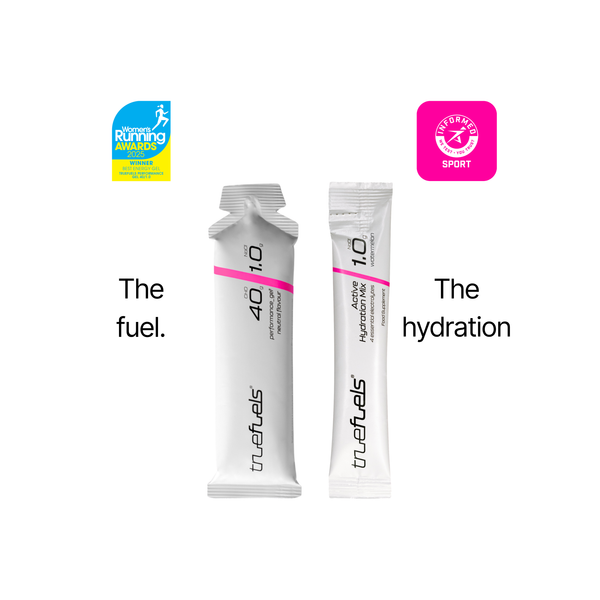
Training Bundle
A practical system for building your gut training block. Use it to practise your fuelling and hydration strategy before race day.
Shop Training Bundle →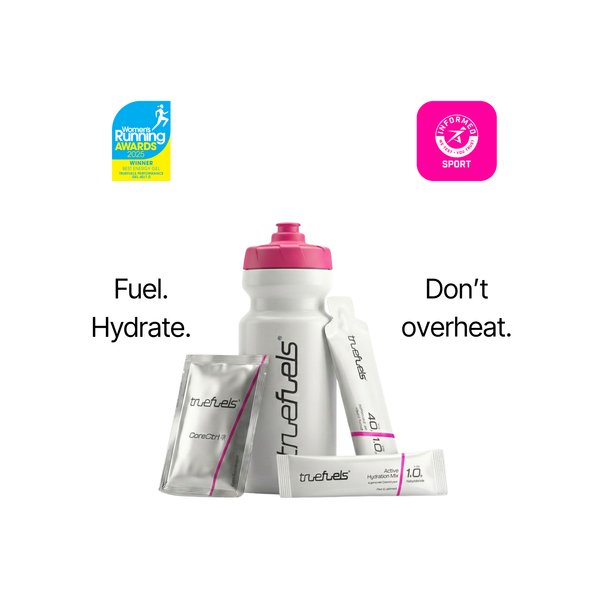
Race Ready System
A complete system for race preparation, including gels, electrolytes and CoreCtrl. Best for athletes preparing for marathons, Ironman, sportives, ultras and hot weather races.
Shop Race Ready System →One rule to remember
Don't chase the highest carbohydrate number you can tolerate. Chase the highest carbohydrate number you can tolerate consistently.
There is no prize for taking 120 g per hour if you spend the final hour of the race with stomach cramps. The best strategy is the one you can repeat every week in training.
Frequently Asked Questions
For runs under 60 minutes, most athletes do not need additional carbohydrate during the session. For long runs over 90 minutes, start with 1 truefuels gel per hour, which provides 40 g carbohydrate. For marathon training and racing, many athletes perform well on 2 truefuels gels per hour, which provides 80 g carbohydrate, provided this has been practised in training.
For cycling sessions over 90 minutes, 1 to 2 truefuels gels per hour is a practical starting point. That gives 40 g to 80 g carbohydrate per hour. For long rides, sportives, Ironman bike legs or very high intensity racing, some athletes may build towards 3 gels per hour, which provides 120 g carbohydrate, but only after gut training.
Most marathon runners should think in terms of 1 to 2 truefuels gels per hour. That gives 40 g to 80 g carbohydrate per hour. Faster athletes or those racing aggressively may benefit from the higher end. Beginners should start lower and practise in training before race day.
Yes. The problem is usually not eating too much carbohydrate. It is eating more than your gut can absorb. Excess carbohydrate can remain in the gut, increase osmotic load and cause bloating, nausea or diarrhoea. Build gradually and practise regularly. Your gut adapts exactly like your muscles do.
Usually because carbohydrate absorption has become the limiting factor. Large doses of poorly absorbed carbohydrate increase osmotic load inside the gut and can cause bloating, nausea and diarrhoea. Using a clean formulation, a 1:1 maltodextrin to fructose ratio and progressive gut training reduces this risk.
Start with 1 truefuels gel per hour, which provides 40 g carbohydrate. Once that feels comfortable, build towards 2 gels per hour, which provides 80 g carbohydrate. Only move towards 3 gels per hour, which provides 120 g carbohydrate, if your gut tolerates it in training. Gut train in at least three sessions each week and use the exact product you intend to race with.
The difference is 30 g carbohydrate per hour. Over a four hour event, that is 120 g carbohydrate, or the equivalent of three truefuels gels. But the more important question is not whether 60 g or 90 g is theoretically better. It is whether you can absorb and tolerate the intake consistently. At truefuels, we simplify the decision into 40 g, 80 g or 120 g per hour.
No. Start simple. Begin with 1 gel per hour, then build towards 2. Only increase further if your gut tolerates it comfortably in training. Nutrition is trainable, but it should be built progressively.
For the majority of endurance athletes, yes. Two truefuels gels per hour provide 80 g carbohydrate, which works well for many marathon runners, Ironman athletes and cyclists. Some elite or very high-intensity athletes may benefit from 120 g per hour, but only after extensive gut training.
For long sessions and races, start before you feel empty. A practical starting point is to take your first gel after 30 to 45 minutes, then continue according to your plan. Waiting until you feel tired usually means you have waited too long.
Continue your learning
Understanding carbohydrate is only one part of endurance performance. Continue exploring the science:

Nutritional Best Practices for Endurance Athletes
Carbohydrates are the body's preferred fuel during endurance exercise. This guide explains why carbohydrate intake matters and how to build a better fuelling strategy.
Read Nutritional Best Practices
The Adventure of a Carbon Molecule
Where does energy actually come from? Follow a carbon molecule from your breakfast to the finish line.
Read The Adventure of a Carbon Molecule
Nutrition for Training in the Heat
Why hot conditions change your carbohydrate and electrolyte requirements.
Read Nutrition for Training in the Heat
Electrolytes Explained
Why water alone isn't enough and how sodium influences performance.
Read Electrolytes ExplainedBuild your personal strategy
Every athlete is different. Your fuelling strategy should depend on:
- Event duration
- Intensity
- Temperature
- Sweat rate
- Experience
- Gut tolerance
Use the truefuels Fuel Calculator to calculate:
- Recommended carbohydrate intake
- Number of gels required
- Electrolyte requirements
- Timing strategy
- Product recommendations
People often ask what the perfect fuelling strategy is. The truth is there isn't one. The perfect strategy is the one you've practised often enough that you don't have to think about it. By race day, your legs should be doing the work, not your brain.
Alistair Brownlee